Rubrics, Guidelines, or Checklists

It is amazing how much I can miss writing my blog.  I am finally going to be able to get back to doing my brain purges here on the Hyler 1 blog.  I apologize once again to my readers for taking so long to write.  Those of you who made requests for certain topics, I will be addressing them through out the next few weeks. Rest assured, I have been writing. I have been working on a chapter that was accepted for a practitioners book and I am working on some other writing for another book.  I am truly glad to be back to writing my blog.

With all that being said, I would like to give some thoughts on rubrics, guidelines, and checklists. Three or four weeks ago I was engaged in a conversation on Twitter with another NWP colleague about rubrics and guidelines.  After the conversation came to an end, I was left with a lot of confusion in my brain.

First, I am an avid user of rubrics, I have been using them for as long as I can remember. I am a firm believer they help my students understand what I want from them when it comes to a writing assignment or a project I am conducting in class.  My colleague stated that they do not like rubrics, they like using guidelines.  Their opinion of using a rubric was that they are too restrictive to the student and don’t allow the student to be expressive.  He liked the use of guidelines better because it didn’t restrict students in what they were doing. He feels the students have to do what is requested on the rubric, where a set of guidelines does just that, it guides the students to making the appropriate decisions necessary for an assignment or project.  Now, do rubrics and guidelines sound the same?  Perhaps they do.  As of right now, I am not sure of the difference.  A typical educational definition of a rubric would be:

an explicit set of criteria used to assess a certain type of work or performance.

For a guideline, it is defined as:

a recommended practice that allows some leeway in interpretation, or how it can be used.

Okay, so based on those two generic definitions, I can see my colleagues point.  However, I am not sure how one switches from using a rubric in class to using guidelines.  In addition, does it make a difference when the students are completing the assignment?

Then, you can’t forget checklists.  Where do those fall in to place.  We all know that checklists are merely there for students to “check” off the items on the list to makes sure they have everything.  For example, I give my students a checklist of items to look for when they do both peer editing and peer revising. But, are rubrics essentially a glorified checklist?  Hmmm. I can’t help but wonder what others are doing in terms of rubrics, guidelines, and checklists.  Furthermore, if anyone is a guideline implementor, how does one implement them into your classroom.

Cheers!


Not Enough Time: Digital Citizenship/Mobile Devices/Discussions

Day 2 of school had its bright spots and its challenges.  We are fortunate enough to have a mobile lab with 30 Dell Laptops for our students to use.  After finishing some typical house keeping items, I was ready to deploy the laptops to my students.  Before I assigned students to a computer, I began by asking students to help me make a list of examples of mobile devices.  The list the students compiled looked like this:

  1. laptops
  2. cell phones
  3. Kindles
  4. PSP
  5. Nintendo DS
  6. Ipad
  7. Ipod
  8. Itouch
  9. Nexus
  10. tablets

It was clear to me, whether it was 7th or 8th grade, the students had a clear grasp on the concept of what a mobile device is.  Upon completing our list on the whiteboard, I shifted their thinking to another topic that involved using mobile technologies; digital citizenship.  As an educator and an advocate for the use of mobile technology in the classroom, I was disappointed when I posed the question: “Who has heard of digital citizenship?” Out of all three of my 7th grade classes, not one student raised their hand.  This is a problem.  By 7th grade students need to be made well aware of what it means to be a responsible digital citizen.  Needless to say, I felt it was necessary to discuss this topic with them.  During our conversation we discussed the characteristics of being a citizen. Students knew that a good citizen participated in community activities, was respectful, followed rules/laws, and needed to be helpful to others.  After students exhausted all the characteristics we talked about how they apply to being a digital citizen as well. Furthermore, I took the time to address cyber-bullying and sexting.  By the end of the week, I would like to develop a handout or sheet for the students to put inside of their planners stating their responsibilities as a digital citizen.  I also want to send the handout home to parents to help educate them as well.  The 8th graders were much  better when it came to digital citizenship and that is because I discussed it with them last year.  I did revisit cyber-bullying and sexting to pound home the importance behind what NOT to do when using a mobile device.

Even though I took more time discussing digital citizenship than what I wanted, it will be worth it in the long wrong.  Laptops were handed out to each student.  I called up 5 students at a time and assigned them a number.  The number they are assigned will be the same number laptop they will use in other classes.  This helps us as the teachers and our tech guy who to talk to if the computer has been used maliciously or it gets broken.  On the whiteboard the students were given written directions on what to do with the computer.

  1. Turn on the laptop
  2. Login to your school account
  3. Access Internet Explorer
  4. Go to www.schoology.com
  5. Watch the short video on the home page

After all of the students completed the tasks on the board, I walked them through the sign-up process for Schoology.  Students were given their individual course codes and then they had to fill in their names, usernames, and passwords.  I directed students to use their last name and first initial of their first name for their username.  For example, mine would by hylerj.  I asked them to make their passwords something easy to remember or use the same password they use for Facebook.  Schoology has an excellent feature available to teachers where they can reset a student’s password if they happen to forget it.  Now, I did run into a few glitches today with students not being able to log in to their school accounts meaning they couldn’t use the laptop that was in front of them.  Such is life when it comes to technology.  I had these students look on with other students who didn’t have difficulty logging in.

Despite the typical issues that came about today, I was able to get everyone signed into their courses I created.  We then walked through the files/links tab and the discussion tab.  We focused more of our attention on the discussion tab.  It is here where we will be collaborating as a class.  I will have the students post discussion questions for socratic discussions we will have in class.  It will be a place I may post reading questions after the students finish a reading homework assignment, and it is a space where students can ask me questions about homework or other assignments.  Today, I simply posted the question, what is your favorite music, music artist and why?  I instructed the students to post their reply and respond to 2 other members in the class.  Prior to releasing them to work on their own, I modeled for them what a quality response is to another member.  Responses like nice, wow, I agree, I like that, and great are not accessible.  I want my students to actually have a discussion, so I direct them to ask questions, be thoughtful and to put some time into their responses.  This conversation and modeling is worth it because students really start to have quality discussions.  Below is an example of what a discussion page looks like.
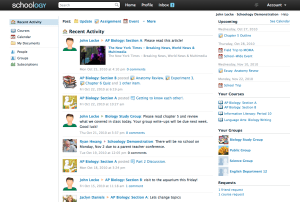
Once students got started, there weren’t any issues with them operating the site.  A lot of students were shocked how much it is like Facebook.  Even though it appears my students may not have done a lot in class today, they did complete at least one of the Common Core Standards.

  • Standards W.7.6 and W.8.6 – Use technology, including the internet, to produce and publish writing and to interact and collaborate with others.

Students were able to identify technology (Schoology) and collaborated with peers and their teacher through technology to enhance their writing.

By the time the end of the day came, I felt like I had been holding my breath all day long.  It never seems like there is enough time to cover what needs to be done.  Tomorrow brings us to Narrative reading.

Cheers!


Grammar, A Debate We Will Have Forever

All summer I have been writing in some capacity. I will be the first to admit, I struggle with grammar from time to time, but who doesn’t?  Grammar has been a perplexing issue for language arts/English teachers for year and years.  Some teachers may argue for a constant drill and kill approach, thinking the more that students do it, the better they will get at grammar.  Other educators let their student’s writing do the talking and examine where their weakness lie in their writing, then they plan and teach accordingly. A balance of both approaches is also used in classrooms.  Despite how you or your district take on the daunting task of hoping your students “get it”, I am here to tell you I don’t believe there is a magic spell out there for the proverbial lightbulb to click on instantly.

My lightbulb burns, at best, about as bright as lamp.  Experts are argue time and time again that we as the writing teachers aren’t doing our job and students are falling further and further behind. Of course, these “experts” are examining standardized test scores as part of their conclusion, and I am not even going to go down that road.  In addition, others believe the use of cell phone and social media is causing students to fall further and further behind because of their “text talk”.  Read this post in Education Week and let me know and others what you think.  I was outraged when I finished reading the post as were others that I have professional relationships with.  It is one more way to blame technology for shortcomings on standardized testing.  Articles such as this gives educators and districts more reason not to embrace technology.  It is bad enough students aren’t getting more of a 21st century education and aren’t connected the way they should be.  I am not saying technology is going to fix the grammar issues that seem to plaque our students.

What I want to say is I can remember all the way back to 8th grade when I had my orange grammar handbook. As a middle schooler, I was clueless from time to time when it came to things such as misplaced modifiers or using a semi-colon correctly.  There were concepts I understood and there were some I did not fully grasp.  I can also remember there were classmates that were way better at grammar than I was.  Sound familiar?  Yeah, the same thing we see with our students today.  Are there better approaches to teaching grammar? My goodness gracious, yes!  I encourage everyone to check out Jeff Anderson’s approach to grammar in his book Mechanically Inclined. I particularly like his express lane checkout approach to the writing his students do in Journals.  There are other methods available too.  Needless to say, our students aren’t going to be grammar experts by a long shot.  Yes, they should be achieving at a certain level, but grammar takes years and years to master in my opinion.  It isn’t going to happen over night and we need to stop whipping a horse that really hasn’t changed much over the years.  Every year I am looking for new ways to engage my students with grammar as should anyone else.  Some ideas work better than others, you just need to find what works for you and your class.  Furthermore, being a writing teacher, means we need to write with our students and only then will our students start taking more of a vested interest in their writing and then maybe they will start listening to those grammar lessons we give.

Cheers!


Enhancing the Classroom With Digital Modeling

The last few days I have been thinking about technology and how it is truly playing a major role in the classroom. I watched a segment on 60 minutes on Sunday about the Kahn Academy and I read an article yesterday I believe in the Washington Post about teaching kids to be digital citizens. First, I want to make it clear I am not going to ramble on about Kahn Academy. I know for a fact it upsets a lot of people and the idea of flipping the classroom is still in its infant stages or at least I feel that it is. It seems to me there are still some things wrong with the idea and I am not going to get into that here. The only comment I want to make about Kahn Academy is it doesn’t do any modeling of reading and writing in the online sessions. Enough said there.

The other day I sat down and had lunch with my mentor and colleague. I had to give a lot of thought about our conversation prior to our lunch. Despite the fact we want our students to use technology, and there definitely is a place for technology in our student’s lives, we need to remember we are the adults and the teacher. It is true, there are too many adults, including educators that are whipping out their phones and checking them in class, professional development, and while they are in line at the grocery store. I am not saying I am innocent of these accusations from time to time, but what is frustrating is watching professionals who scold students every day about being on their cell phone or keeping their cell phone put away, and then seeing these same adults pull out their cell phone during a professional development session and vigorously text, surf the Internet, or play games. We can’t hold our students to expectations that we ourselves are not willing to follow. It seems digital natives have not been given proper instructions on how to handle the devices they come into contact with each and every day. Essentially, they need digital modeling by teachers, parents, and other important adults in their lives.

In my opinion, if we as educators are crying to use more technology in our classroom, we need to model for our students when it is appropriate. Just today I heard on the news that 62% of students ages 6-15 are more likely to find the answer to a question on Google rather than ask their parents. Upon asking my students about what was more accessible, the Internet or their parents, it is evident students rely more and more on the internet. As troubling as this might seem, we still have a responsibility to teach today’s youth how to be responsible digital citizens. After all, technology and digital tools are meant to enhance our student’s learning, they are not meant to be a toy plopped in front of them for entertainment purposes.

Cheers!


Not Too Much: Slowly Approaching the 21st Century Classroom

Moodle, Google Docs, Glogster, Edmodo, WordPress, Blogger, Vimeo, Diigo, and Wikis. Are you out of breath yet? If your not, you are one of the 21st century educators who are implementing digital tools into their classrooms. If you are just laying foot to path and beginning your journey into all of the wonderful digital tools that have the potential to transform your classroom, the choices can be a bit overwhelming. This is just one of the many thoughts I had yesterday attending the pre-conference sessions at MACUL. As I sat through a moodle and a web publishing session, I began to wonder what my prospective would have been if I was new to all of this. Rocking in the corner with my arms wrapped around my legs came to mind. It wasn’t that long ago when I went through the summer writing institute and our director Troy Hicks gave us a plethora of digital tools to use. There were days I had anxiety, but everything in the end worked out. I get excited about challenges and persevered through it all. I honestly believe teachers can transform their classrooms into 21st century portals where the students can once again be excited about learning.

So, how do you begin with this barrage of digital tools being thrown at you? First, simply start by picking just one tool to implement into your classroom. A great colleague of mine Kevin Hodgson commented to me about students and technology users alike are leaving “digital debris”, meaning we try new things out and think it is great, but then we never use that tool again. Students and users have created accounts, used it one time, then never go back. I know I am guilty of doing this very thing this year with Edmodo. By choosing just one tool, you can use it over and over during the school year. Essentially, by the end of the year, your students and you will be become an expert on that tool. Furthermore, you as the leader in the classroom, won’t feel so overwhelmed. Then, the following year you can stretch your zone again and try something new.

Next, after you have chosen the digital tool you want to implement, ask yourself two questions. First, why am I using this in my classroom? Second, why is this tool valuable to my students? The first question was an eye opener for me. I have to thank Troy Hicks again for pushing me in this thinking. Now, I am passing it on to you. Simply using a digital tool because it looks fun or the students like it, aren’t the most important issues here. Some tools are geared towards a language arts classroom, where another one might be more science oriented. In addition, some schools may not have up-to-date technology capabilities that support the tool you want to use. More importantly, with increased rigor and higher order thinking wrapped around the Common Core, it is essential to stop and think about how the tools we are using are helping to develop these very traits within our students.

I leave you with the the advice to go slow, find what is easy and works well for you and your students. We all have to shift our learning styles and our minds to the 21st century and how our classrooms are going to look.

Cheers!


What Now? Dealing With Intelligence

Every single day we face challenges as teachers. Whether it is a discipline problem or something as simple as what lesson is going to most affectively reach a class, we go home exhausted every day because we are doing our job well. For the past week I have had something plaguing my brain like a tick sucking blood from a dog.  I know, a bit extreme right?  Let me enlighten your brain as to why I am feeling this way.  I start by asking you a question: What do teachers do with a student who is not meeting curricular requirements in school?  Wait…wait, I know what you are going to say.  Sit back, there is more.  The student is a middle schooler who could potentially be starting drivers training within a year.  They have been tested to receive special education services and did NOT qualify.  They are a constant disruption to every classroom they enter.  Said student is not at grade level with reading, writing, or math.  The teachers are in contact with the parents on a weekly basis and everything is documented.  There have been several teacher meeting about this individual to help make this student more successful in everyone’s classroom. So, what is a teacher to do?

When all avenues have been exhausted it is difficult for any teacher not to feel frustrated with the performance of the student.  After all, we want to see our students be successful. I wonder if there are not only other teachers who feel the way I do, but are there other students who fit the same profile?  Retention is always an option that is on the table, but by the time the student graduated he could be twenty-one years old.  Because this individual does not qualify for any type of services, I find myself wondering what more can be done. What drives me bonkers the most is how he disrupts other around him.  Besides a behavior plan, an academic plan can be put into place putting benchmarks before the student to reach, but with no motivation from the student, it proves worthless.  I am not a teacher who is just going to let a student of this caliber slip through the cracks.  Unfortunately, I have seen this before and the student continues to play catch-up for the rest of their school career.

Let’s face it, every year we encounter students who just don’t want to be at school. I don’t claim to be the world’s best teacher, but I work my tail off to make sure my students get the best education possible.  I know I don’t reach every child I come in contact with, but I know if I reach a few, I can feel confident I am doing my job.  Now, I worry about students that I have described.  Our state is coming out with stringent evaluation tools for teachers.  If there is proven growth in my students, my head is on the chopping block.  I can’t help but think low achieving students, who have absolutely no motivation, will affect my evaluation because there isn’t any growth being seen.

I will continue to push forward and do what I can to help any struggling student in my class, but when there is a lack of motivation and intelligence, I need my colleagues, my administration, and my parents for support. I am open to any suggestions.

Cheers!


Understanding and Implementing the Common Core

Michigan is one of many states who have adopted the Common Core National Standards. More and more I read both negative and positive reviews of the CCSS. I am sure the more educators, professionals, and school districts unpack them, there will continue to be the emergence of these types of reviews. It isn’t a secret schools districts will be tested over the CCSS in 2014-2015. To me, schools will not be successful if they plan on implementing and reviewing the standards the year before they are being assessed. I am utterly shocked at the number of schools who have NOT implemented or even looked at the CCSS when my PD partner and I are delivering our breakdown of the informational writing standard. A word of advice to those schools; you better start.

In addition to districts and teachers themselves, I question what is happening at the university and college level in regard to the Common Core. For the past month I have had a mid-tier student in my classroom from a university/college that I will leave nameless in my blog. Mid-tier students have to complete so many hours of observation as part of the teacher-education program. These hours are completed before they begin their student-teaching. I remember having to do the same thing during my undergrad work. Last week my mid-tier and I were having a conversation about a lesson that needed to be taught in my classroom and after establishing it would be a lesson on grammar, I asked what they knew about the CCSS. The response I received just about knocked me down. Though they knew of them, they were not being discussed in the classes they were taking. According to my mid-tier our states Grade Level Content Expectations(GLCE) and something else called the high school content expectations(HSCE) was supposed to be the focus of the students. Now, how is not discussing the Common Core preparing new teachers for the classroom? I asked my mid-tier to go back and ask their teachers about the CCSS and why they weren’t being baptized into the world of the new National Standards.

The following week I had a follow-up conversation with my mid-tier and it according to them there seems to be a lot of finger pointing going on. Education professors are saying the English professors should be covering the CCSS and English professors claim the Education professors should be covering them. It seems we have a failure to communicate people! It’s obvious to me there is a problem. What is it? It’s not being taught. My mid-tier even brought it up in a class and other students wondered too why it wasn’t be addressed with them and the professor told them they wouldn’t be covering it at all. We aren’t doing young teachers-to-be any services if they aren’t being kept up to speed about curriculum and standards. Now, I am not attending these classes my mid-tier is taking, so I don’t know the whole story. All I know is something isn’t stirring the Kool-Aid. I did have an opportunity to fill out an online survey provided by the college/university and expressed my concern pertaining to the Common Core and I did receive an email back and was told my concerns would be addressed.

If individuals are under the impression the CCSS are going away, they are are wrong. The time is now to start thinking and acting and that does include individuals at the college level.

Cheers!


Dodging Digital Difficulties: Implementing Digital Tools in Rural Schools

Is there anyone else out there who get the feeling from time to time that people are either reading your thoughts or they are on the same wave lengths as you when it comes to specific topics.  I have been freaked out twice by this in one day and though it can be a little spooky, I feel like I am making connections with people and it feels great!  This is how I felt when I found this great video on what it is like to teach teaching in rural America, that was tweeted by my national writing project colleague from West Virginia April Estep. You can follow her at @MsEstep on twitter.

I am not going to lie here folks, I know funding is an issue and every school district could use more money.  On the other hand, throwing money at the situation doesn’t always fix the perplexing problems we have in our rural schools.  And yes, I do teach at a rural school! With that being said, I know there are many rural schools that face technology issues in their district and each district can be very limited when it comes to students being able to access technology.  Believe me, I am guilty of crying and whining and wanting to kick my feet in frustration because I don’t have access to working computers or my students can’t use computers on a regular basis. Realistically, I strongly believe we waste more time complaining when we can find ways to improvise the use of technology.

First, I urge you to open up the use of cell phones in your classroom or your district.  My district is going to re-write the policy it has on cell phones just so students can use them in class.  I currently use Celly in class and Wiffiti has been suggested as a great tool to use too.  Second, I would like to suggest using something like Grammar Girl in your classroom.  There are multiple podcast for free available on many grammar issues.  My students love the fact they don’t have to always listen to me preaching about grammar.  Most audio sessions or lessons are no longer than 6-8 minutes.

Finally, as one last suggestion I would like to offer up the idea of students doing a paper blog.  Blogging on a computer can be challenging for teachers and educators that don’t have technology readily available to them.  However, that doesn’t mean we can’t teach students what a blog is and why people write them. Give students an opportunity to create a “paper blog”  This is a lesson I plan on sharing with my students on January 30th and then they will create their “paper blog” on February 1st.  There are many different ways to approach this lesson.  You can check out some paper blog activities on http://langwitches.org/blog/2008/12/27/blogging-lesson-plan-writing/.

So, channel that valuable energy for positive use and be creative in your classroom to help our 21st century learners.  Other simple ideas could be to allow students to bring in their Kindles and Nooks and designate some time to let them read.  Allow students to have their iPod or iTouch in class to use for a day.  Calculators on cell phones are also ways we can get around budget constraints for our students.

Although my suggestions may not fix the bigger problem, there are still other avenues to explore for implementing a digital world into our classroom.  My school isn’t perfect by any stretch of the imagination.  However, I have hard-working colleagues who are willing to put in the extra time to find grants and figure out what it is going to take to make our school more 21st century friendly.

Cheers!


Why is Collaboration Almost Non-Existent?

Monday I had another wonderful opportunity to conduct professional development at Central Michigan University on Informative writing as suggested by the Common Core Curriculum. I was very impressed how the conference was set-up and the number of people from all over the state of Michigan that attended. There were even administrators present.

As my writing project partner and I were giving our presentation we had several questions surrounding informative writing and the Common Core. We discussed with our audience about the unique opportunity we have as educators when it comes to the Common Core. What we were echoing from our director Troy Hicks is how we, as teachers and school districts, can decide how to assess students based on the Common Core. If teachers don’t look closely at the Common Core and make these type of decisions, they could be made for us from the powers up on high. The biggest idea we preached was collaboration with colleagues about creating units and assessments and implementing 21st century tools such as Google docs, cell phones, Glogster, etc. and making sure those assessments and tools that teachers choose to use tie back into the standards.

One question we had was from a teacher who virtually was on an island by herself in high school. She taught language arts for grades 9-12. She wanted to know how she was going to be able to collaborate with other colleagues when she was the the only high school L.A. teacher. Other teachers talked about how they didn’t gave any collaboration time at her school and she wanted to know how to get that time. We even had a principal say he was going to go back to his school and figure out how to develop time for his teachers to collaborate on the Common Core.

To answer the 9-12 teacher’s question along with the other teachers, we simply encouraged her to collaborate with the middle school staff and the elementary staff within her district. We even told her to email or call other teachers in surrounding districts.

What I have been absolutely amazed by all week is how many districts were not collaborating. And not just on the Common Core either, in general it was appearing teachers weren’t collaborating on much at all? Why is this? After talking with teachers this past Monday, I feel spoiled about how much time is available to me and my staff to meet. Not only do we have common planning time in my middle school, but we also have something called “early release” district wide. This is where once a month we meet as departments and discuss what is going on in our classrooms, textbook selection, teaching strategies, etc. Most of the time it is just building wide, but on occasion we meet district wide K-12. Recently our principal implemented meeting times in different areas such as literacy and transition. These meetings are also conducted once a month. Again, I feel more fortunate then most districts because it appears they aren’t getting the same opportunities.

Even if you aren’t in a district where you should be collaborating, the bottom line is you need to be, especially when it comes to the Common Core. Schools will be required to start assessing students in 2014 and if these conversations are not taking place, it is going to be more difficult to implement the Common Core Standards.

What can you do? If you are a teacher, start by talking to your administrator and your colleagues. Discuss a time you can all discuss the CC. Yes, this may mean you have to sacrifice time after school, particularly if you don’t have a common planning time. Second, attend professional development on the national standards. Educate yourself and become the “expert” your school district may need. Finally, email, call, or Skype with teachers and professionals in other districts to help you get off on the right foot. After all, teachers teaching teachers is powerful and everyone involved can benefit. For the most part, we are all in this together and we need to be willing to work together. It is exciting to think of all of the creative and amazing assessments that can come out of the the new standards laid before us!

Cheers!


Motivation: For Teachers

The last few days of break have been very cumbersome for me. I have felt weighted down, not very energetic, and somewhat irritable.  Nevertheless, I knew the alarm would go off at 5:50a.m. this morning and I would have to be ready for my students. A very perplexing issue that has risen to the top of my thoughts over the past few days is the term motivation.  Yes, I truly believe as educators, we come back from Christmas break re-energized and ready to teach our students to the best of our abilities. 

 On the other hand, I know as a teacher in the great state of Michigan, we pray for snow days too.  Or at least I know I will be wanting a snow day. Why?  In my school district we don’t have another break until the start of our Spring break which is April 2.  Now, I know some school districts have a mid-winter break in February to try to break things up, but I do not.  So, I had to ask myself the last few days, what is going to keep me motivated to get me through this long stretch.  Because to be honest, mother nature doesn’t look to be on my side.

The first idea that came to mind was professional development.  This is a great time of year to be a part of some sort of professional development that your district or local university may be hosting.  I might suggest finding some professional development on the Common Core Standards.  I recently enrolled into a professional development book club about the Common Core and Project Based Learning.  I am looking forward to attending.  In addition, I am helping our Writing Project Sit with professional development about informational writing and the Common Core.  Needless to say, there should be plenty of opportunities for any educator out there to imerse themselves in PD.  I find PD does two things for me.  First, it obviously gives you a break from your students and your classroom where the stress can mount quickly.  We all need adult interaction once in a while.  Second, I always get that refreshing feeling that we all need. I become armed with strategies to use in my classroom and it almost feels like a coach has given me a pep talk.  Once again, I am ready to go!

Besides professional development, I encourage anyone to write.  Writing has helped me so much since being part of the National Writing Project. Troy Hicks, our site director, was intense and challenged us all.  I am the writer today and the teacher I am today because of him and the National Writing Project.  Writing is a great outlet to express your feeling and your ideas.  In addition, it makes you feel better when you are done getting your thoughts down on paper.  Writing can take the form of a poem, journal, song, etc.  I even encourage you to enter a writing contest.  There are plenty of them out there.  Figment.com is a great website that hosts plenty of writing contests. 

If professional development and writing don’t sound the most appealing, I encourage you to start a book club with friends or colleagues with a New York Time’s bestseller, or any other book that may be of interest.  If that doesn’t sound like your cup of tea or might be too time consuming.  Befriend a colleague and go out for a nice dinner and perhaps vent to each other about the challenges you face in your classroom. 

Whatever avenue you choose to take to keep yourself motivated and doing your best as a teacher in your classroom, I know this time of year can be challenging.  Lean on each other professionally to help!

Cheers!