Digital Portfolio Resources – Technology & Writing: New Approaches to Literacy Competency

 Below you will find many resources for using digital portfolios in the classroom.  Comment with any questions!

Digital Portfolio Websites

  1. http://www.michiganportfolios.org/
  2. http://electronicportfolios.com

Book Resources on Portfolios

  1. The Digital Writing Workshop by Troy Hicks
  2. Because Digital Writing Matters: Improving Student Writing in Online and Multimedia Environments by National Writing Project, Danielle Nicole DeVoss, Elyse Eidman-Aadahl and Troy Hicks

The Many tools for Digital Portfolios

Cloud Based Spaces:  

Social Media Sites

Creating a Website


Marking Period Portfolio Reflection Questions:

  1. What piece did you choose to reflect on and why?
  2. What was your initial response to the comments by Mr. Hyler?
  3. In your own words rewrite what it is that Mr. Hyler commented on.
  4. Give an example of how you are going to make your writing better based on the comments by Mr. Hyler.
  5. How are you going to apply what you learned from reflecting on your writing to future assignments? Be specific.

End of the year Portfolio Reflection Questions:

  • What were your expectations for this class before we started? Was the class what you expected? What goals did you set for yourself in regard to this class? (Check your writing into the day from September if you don’t remember.) How successful were you in accomplishing your goals? What is the most useful thing you’ve learned in this class? How have you grown intellectually this year? Academically?
  • Look through all the writing you’ve done this year. What have you tried that is new? How has your writing changed?  What is your favorite piece and why? Is there anything you wish you would have done differently? How do you think of your writing abilities now compared to the beginning of the class? Has anything about your writing surprised you? What have you learned about the various kinds of writing you’ve done (narrative, informational, and argumentative)  What did you learn about revision? What kinds of feedback from your peers is most helpful?

Just Hanging Out…and Learning

This week has been crazy to say the least.  On the other hand, it has been phenomenal!

Tuesday, my 2nd hour seventh grade class began an adventure I felt was worth taking.  For quite some time a writing project colleague and myself had discussed having our classes collaborate with each other using Google Hangout.  If you do not have prior knowledge of Google Hangout, it is just that, an online space for people to collaborate via web cams and voice chat, or…hangout!  I believe up to 10 people can chat at the same time. The idea was brought on by our discussions we have had previously about using digital portfolios.  Eventually we decided we wanted our students to collaborate and discuss the myths that each our classrooms were reading and writing along with have the students publish their writing to a broader audience.

As we searched for a common time for our students to meet online, it occurred to us that we needed to introduce our students to each other before we did any real collaboration about the myths.  Each of our classes had written “This I Believe” essays, and we decided we would use these essays as a mean for our students to get to know one another. Because my own students had already written their essays at the beginning of the year, it was a great time for my students to reflect back on their writing to polish it and decide if their beliefs had changed at all.  Furthermore, they needed to understand their writing was going out into the bigger world for people to see and they needed to clean it up before publishing.

Prior to work with the essays, we showed our classes our school websites, discussing  with students what they noticed.  In addition, any questions they might have.  Before our meeting on Tuesday each of our classes composed questions to ask one another.  As we were hanging out, the students went in front of the camera  and asked questions about each other’s school.  For example:

  1. What types of writing have you done this year?
  2. How many students do you have in your middle school?
  3. What sports can you play at your school
  4. What do you do for fun?
  5. Can you choose your own electives in middle school?

After the students took turns asking questions and answering them, we talked with the students about what we were going to do next with them.

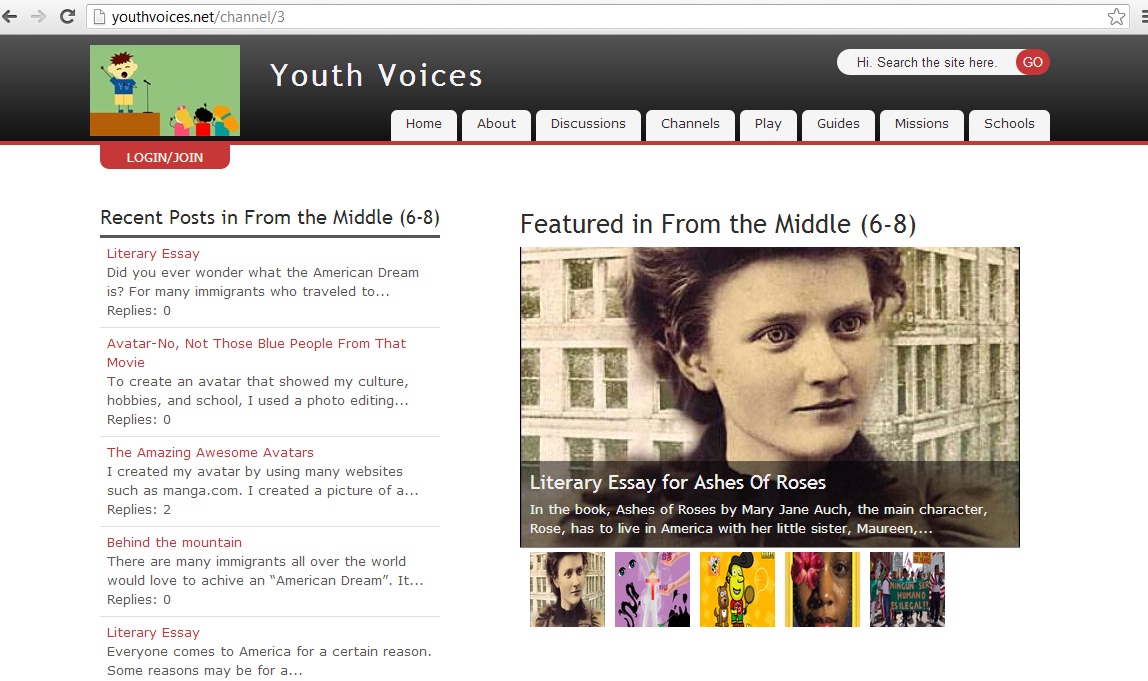
As I mentioned earlier, the students are using their “This I Believe Essay”  to get to know each other more. My colleague and I decided we would have the students post their essays on Youth Voices. Youth Voices is an online platform where students can publish their writing where other students can discuss the same topics or issues.  By having the students post here, they could read each other’s essays and respond appropriately.

Youth Voices (youthvoices.net)

Youth Voices (youthvoices.net)

This allows the students to see what beliefs they may have in common or what they may not have in common as well.  Regardless, we feel that our students are now publishing their writing for a broader audience besides their teacher or classmates. Furthermore, they will get feedback that can have the potential to make them better writers in the future.  After our students have posted to Youth Voices and everyone has had a chance to be paired up to respond to at least one other student, we will move forward and participate in doing more live hangouts where our students can discuss myths.

Reflection

Doing something this simple with technology has long lasting impacts on the students from each class.  First, I would like to say our schools are very different when it comes to the dynamics of the number of students and the cultural diversity.  My middle school consists of 120 seventh and eighth graders.  My colleague has just over 500 in the same two grades.  My school consists of about 98% whites where his school has Latinos, Hispanics, Arab, African American, and whites.  With this being said, I felt it was wonderful for my students to be emerged into this type of cultural diversity.  Our students need to learn they will be working with a very diverse culture when they enter the work force.

I was also surprised at how my students “locked up” when it came time to talk on camera.  They were dead silent and if it wasn’t for the fact I had students assigned for each question being asked, I would not have had volunteers.  My students were very shy and I was shocked at this.  In the end, when it came to them talking on camera, they needed to speak up too.  My colleague actually felt his students were rude and too loud.  A concern, I actually thought was going to arise.

Overall, Google Hangout and Youth Voices are great tools, especially ones that can help meet the demands of the Common Core Standards. The ideas behind using the online tools were to:

  • Collaborate
  • Practice communication skills
  • Publish student writing to a broader audience
  • Receive feedback on student writing
  • Become connected with other learners
  • Be exposed to more diversity as is such in the real world

Cheers!

Will the Common Core Burn Out Teachers?

I am almost 1/2 way through the 3rd marking period and I am not going to lie, I am exhausted. Now, I do have a full plate when it comes to everything else going on in my life, but I want to talk about just teaching for a moment. Despite the fact I just turned 35, I have no plans of slowing down anywhere.

Anyone who knows me, realizes I do not settle for average. It is one of the main reasons my principal and I get along so well. I work hard for my students and am trying to set an example for them all. In addition, I am a supporter of the Common Core State Standards (CCSS) and see endless Possibilities. Freedom to be creative with assessments, integration of technology, collaborative learning, more vigorous learning (Yes, I said vigorous, not rigorous!), and the idea students can do research projects are just a few reasons why I see the upside to the CCSS.

On the other hand, I hear and read the negativity about the Common Core weekly. Teachers don’t think it is clear enough, they feel the need to start over with lesson and unit plans, others feel the Core has unrealistic expectations for students from kindergarten to twelfth grade.

I hear everyone loud and clear and I am not trying to add to the complaining, but I am wondering if the Common Core is going to push some teachers over the edge. Currently I teach both 7th and 8th grade English and the CCSS is fully implemented. My lessons are not only driven by the Common Core, but I also do sample Smarter Balanced Assessment questions with each of my classes. I have very little time to do anything else. I am sure other teachers feel the same way.

With little time to breathe, I worry about a few things. First, I worry about the potential for quicker burn out amongst younger teachers who are entering the profession. Are the younger teachers going to feel the task of implementing a challenging curriculum too demanding? Will the CCSS overwhelm them to the point they seek other job opportunities? I guess time will tell.

In addition to new teacher burnout, I worry about teachers being too accepting of a canned curriculum program that teachers will purchase so they don’t have to do any work as far as creating thoughtful and inspiring lessons. It is a concern that is a reality, trust me. There are many textbook companies and publishing companies that are going to produce Common Core guides, lesson plans, how-to’s, and many other resources. Eventually, the market will be flooded with a plethora of information on how to reach our students through the CCSS.

In all honesty, it is going to take hard work and determination to elevate our students to the level they need to be. It is going to take collaborative meetings between elementary, middle and high school teachers to sort out the finer detail. We will be forced to rethink what we are doing in our own classrooms and reevaluate what can stay and what has to go. It is not going to be easy and thus far, for me, it hasn’t. However, I will continue to push forward and do what it takes to be successful with my students. Even if it means I take a thermos of coffee into work everyday to stay awake.

Cheers!


As the Common Core Band Wagon Rolls By, I Stand and Wave

I wasn’t sure how to title today’s post.  I hope by the time anyone reads this, my post is well understand.

Recently we had another department meeting and I must say I enjoy our department meetings because we are always busy and engaged and trying to do what is best for the students that face us every day! One of the high school teachers was feeling the pressure of potentially not doing enough to meet the demands of the Common Core State Standards. The word rigor came into focus (See my previous post on rigor -vs – vigor). As the conversation progressed,  I couldn’t help but wonder how many other teachers are feeling the way my colleague has been. Their thinking was perhaps if  they used another Shakespeare unit in addition to what they were already doing might make their class more demanding and students would be required to do more deeper thinking.  Note to anyone: Adding more, does not mean a class is more rigorous (My colleague wasn’t thinking this, I just wanted to throw that out there).

This also spurred the conversation about looking at different curriculum in general to use in the classroom.  Though we weren’t considering replacing what we are currently doing, we were discussing what other possibilities could be included to extend our current practices or what were valuable resources to aid us in our teaching.

I have done a lot more thinking since that meeting and my colleague had a great point about what they have observed.  The sad thing is, I have observed it too. We have both noticed this mad frantic race to implement Common Core and have heard teachers discussing how their schools have these curriculum teams to rewrite their entire curriculum and these huge meetings are taking place to change to the CCSS.   In addition, everyone is making this mad dash to find the best books that are available to help them implement the CCSS.

Well, as I stand here and wave at the bandwagon rolling past me with others on it, I will tell you I haven’t completely changed my curriculum or gone to some canned program that companies might be trying to sell to schools and teachers. When my school did switch to the Common Core, I got out my curriculum and went through it with the Common Core Standards right next to it.  I went through and looked at what standards I was already meeting with the existing units and lessons I was teaching. Now, was I missing some things?  Absolutely! I will admit, I had to do some overhauling in some areas and not so much in others.

What I didn’t do was scrap everything I was doing in my classroom and look for the easy way out by trying to find existing CCSS units.  The Common Core allows us to use what we already know and it also challenges to implement new ideas and technologies.  I strongly believe if teachers are trying to find the magic button for teaching the Common Core in their classroom, they are going to be really disappointed, because there isn’t a magic button to push.

So, if you feel you are one of those people who are completely lost and you hope there is going to be this miracle curriculum program that is going to come out for you to use in your classroom, I invite you to examine what you are currently doing in your classroom first before jumping on the band wagon.  If you do jump on, I will be waving to you as you roll past!

Cheers!


Rigor -vs- Vigor

I have officially arrived at NCTE. As a first time Vegas guest, I must say it is crazy. My body has not transitioned to the time change and I am up at 5:00 a.m. working on my blog. A nap may be order later, but who knows with so many great sessions.

Speaking of great sessions, yesterday evening Barry Lane gave another one of his spectacular performances for NWP teachers. Though I didn’t attend earlier annual meeting sessions, my NWP peeps convinced me to peek in on what Mr. Lane was doing. If you have ever been to one of Barry Lane’s presentations, you know it is very entertaining and informative.

After laughing continuously and feeling energized as ever, he brought up the term “rigor”, which has been associated with the Common Core Standards since they have been released. Teachers are supposed to have more “rigor” in the classroom with the CCSS. When he asked a woman in a video what her definition of rigor was she stumbled and passed the buck on to her friends that she was standing with. Needless to say, their definition was less than perfect. So Mr. Lane put up the first six definitions of rigor from the dictionary. Here are a few of them!

1. Strictness, severity, or harshness, as in dealing with people.

2. A sever or harsh act, circumstance, etc.

Does this sound like something we should be infusing into our classrooms? Barry Lane had a few other definitions from the medical dictionary too. One medical definition is, shivering or trembling, as caused by a chill. Again, do we really want to be teaching something like this in our classroom? Tom Romano was even in a video where he said rigor is the sister of mortis. I cracked up on that one.

Instead of “rigor”, Mr. Lane said we should be teaching “vigor” instead. I couldn’t agree more, especially after seeing that definition

Vigor

1. Healthy physical or mental energy or power; vitality.

2. Force of healthy growth in any living matter or living organism.

Perhaps the two are easy to confuse. I know that vigor sounds much more appealing and attainable in my classroom. I also know “rigor” can occur in my classroom too and if I adhere to the definition, my students are going to get turned off as learners. Can there be a balance of both? What are your thoughts?

Cheers!


Welcome Back

Well, my summer break was officially over this past week as I trudged through my mornings with my coffee in hand trying to fall back into a routine that will be a part of my daily life starting Tuesday.  To those teachers and administrators that have been back for awhile, I hope all is going well. Welcome back everyone!

It has been a busy summer and one of the best I have had since going through the summer writing institute in 2010. With that being said, I went back to school Monday with an open mind and an understanding that things were going to be different again. It seems over the past 5 years that I have been teaching at the middle school level, there has been some type of change; whether it has been teaching assignments, new staff, or even new administrators. The week was interesting, but also very trying.

I applaud my principal for keeping an open mind to the use of technology in the classroom. We had a two hour segment titled 21st century learning and there were three staff members who presented, including myself.  My principal wanted us to share what we were doing in our classroom to engage today’s learner.  Three different digital tools were presented to the staff:

  1. Moodle
  2. Celly
  3. Schoology

I of course being the big Celly user introduced this to my colleagues.

The middle school science teacher discussed Moodle, which I do not use and do not really care for.  I find it difficult to navigate and not very user friendly for the students.

Finally, one of our high school language arts teachers showed Schoology. All 7th-11th graders will be using Schoology this year as a way to communicate, get access to assignments, and collaborate. Parents can even see what is happening in class.

One of the bigger issues at the helm was student growth.  Our beloved politicians in my state want teachers to be able prove they are doing their job by displaying there was student growth.  What is this supposed to look like?  Well, that is superb question.  One way our principal wants us to show student growth is by giving a pre and post test.  In addition, we were to discuss other ways within our departments how we could potentially show student growth.  The language arts department discussed writing portfolios and the possibilities digital portfolios bring.  With students from grades 7-11 using Schoology, it would be easy to pass their digital portfolios from year to year.  Schoology syncs well with Google Docs, so students can create folders within Google docs and put their writing samples in it.  The more important question is what is the definition of student growth? If a student scores one more right on the post-test than what they did on the pre-test, is that considered student growth? What is classified as being proficient? 75%. 80%. It was a conversation that quite frankly literally gave me a headache.

I deem myself as a hard working teacher and I know my students get better by the end of the year, but what truly is an accurate way to measure student growth.  I am curious if there is anyone who has suggestions.

I am blessed to have a job and I love being a teacher. I know I will have another successful year based on the mere fact I will engage my students each and every day.  I want my students begging me to keep reading and writing.  That is my measure for student growth.

Keep reading and spread the word.  I want to write everyday during the school year.  I want to use it as a reflective time to help me form my thoughts for the book I am working on.

Cheers!


21st Century Classroom

The term 21st century classroom is utilized a lot now.  Teachers and Schools alike are making steps towards a 21st century classroom. The steps may be small, (perhaps a crawl) or big; nevertheless, classrooms are edging towards a change.  I think there can be some confusion on what that type of classroom looks like.  In a recent conversation with a fellow Tweeter we were both examining a graphic that I found through another tweet. Below is the graphic.  You can read it better here.

The idea behind the picture is to show all the ideas, activities, etc. that goes on in a 21st century classroom. Though I want my students to be a part of classroom where there is technology use, it doesn’t mean students are sitting in front of some sort of mobile device, desktop computer, or laptop and I, as the teacher, am sitting at my desk while they work.  The picture does a poor job of truly showing what technology can do to transform a classroom.  The picture would be more powerful if it showed students sitting in a group collaborating with a digital device. To the left of the picture where the two hands are joined it states, “Integrating life skills into education can improve student engagement and retention and prepare them for 21st century careers.”  Collaboration is a life skill and is more important then ever. And with social media (mentioned in the bottom right hand), collaboration is inevitable. So, why isn’t this life skill being displayed?  Also, with teachers getting such a bad rap these days, why isn’t the teacher interacting with the children in this chart?

I do realize it is simply displaying the components of a 21st century classroom, but the graphics and some of the statements don’t truly deliver the power behind a 21st century classroom.  For example, my classroom is without a doubt 21st century.  As I have mentioned before my students use Celly.  To me, a 21st century classroom goes beyond the walls of my room.  Though I use Celly within my classroom, I have had many thought provoking conversations with my students outside of class.  Just this evening, I was chatting with some students about Oxymoron in literature and real life.  Digital tools such as mobile devices and Celly make it possible to show how students are learning beyond the walls of the classroom and this one conversation I had, truly reflects the capability of a 21st century classroom.

The picture also gives the top three reasons for teachers using technology in the classroom and I do agree with each of them, but we also need to realize one of the biggest reasons technology should be used is because we are dealing with digital natives.  My five year old reads on my ipad and his kindle fire.  The internet wasn’t even a huge deal until I was a freshman in college.  If we want to get through to our students and motivate them, we need to adapt our lessons to our audience.  To teach a 21st century learner, we must become a 21st century teacher. The Common Core Standards even address technology. A 21st century classroom is much more than placing equipment in front of our students and saying, “Have at it!”  It requires us to be up-to-date on the latest tools and possibly attend professional development to make us the 21st century teachers we need to become.

Cheers!