Transitioning from Narrative to Informational

Pushing forward this time of year seems to be a slow process and transitioning from narrative to informational reading and writing can be a rather challenging task with 7th and 8th graders.

Previously my students just completed a 12 week journey with narrative reading and writing.  From memoirs, to This I Believe, and on to mysteries, my students did a lot of reading and writing in the narrative world.

With the narrative unit in the rear view mirror, it is time to emerge my students into the informational world.  Before I write about my introductory lessons for this unit I want to share with you some thoughts shared at a few conferences I have attended since last Spring.

Recently I returned  from Las Vegas and the NCTE conference. While there I listened to Kelly Gallagher speak about writing in his classroom.  He echoed the thoughts he had at the end of  his book Write Like This: Teaching Real-World Writing Through Modeling and Mentor Texts about great writing isn’t just narrative alone, informational alone, or argumentative alone.  Great writing should involve elements from all three or at least more than one.  Jeff Anderson said the same thing at a session I attended last year at MCTE.  While trying to motivate us as writers, he pointed to a book on the triangle fire and discussed with us how the book used both narrative and informational elements to reach the reader.

Now, I relay this information because I want educators to understand that though I spend a lot of time on separate units revolving around Narrative, Informational, and Argumentative reading and writing, I am also building on each unit as I enter the next.  For example, I began my unit by displaying some of the Common Core Standards.

  • (RL.7.1) Cite several pieces of textual evidence to support analysis of what the text says explicitly as well as inferences drawn from the text.


We discuss the idea that informational reading and reading is used to inform and explain a given topic. I tell my students they are going to hear the words inform and explain A LOT from me.

Then,  we generate a list together on a shared Google Doc where they see information reading or writing.  Below are a few items they listed:

  • Magazines
  • Letters
  • Newspapers
  • Internet searches
  • Business cards
  • Flyers
  • Brochures
  • Twitter
  • Facebook

When the students were done adding to the list we took some time to talk about what type of information each of these genres were trying to inform or explain or what was the purpose.  I was very satisfied with the conversation that took place.

To help demonstrate to students(7th grade) that there are reading selections with both narrative and informational elements I chose the short story “The Green Mamba” by Roald Dahl.  When the students were reading it they completed a T-Chart with one side labeled Narrative qualities and the other side labeled Informational qualities.  If you visit the ReadWriteThink website you can find a really nice T-chart for the student to use. When students complete the T-Chart I have them listen to the short story on CD (RI.7.7) and they complete a short quiz about the selection.

I feel my students begin to understand how a reading selection can have both narrative and informational qualities by completing the T-chart and listening to the story again.  The short story serves as a quality transition piece for my students as we dive into informational reading and writing.

Today we discussed Facebook and the type of information the social media website portrays.  After taking a short survey with my 8th graders, about 80% of them have Facebook but do not visit their page that often.  Most 8th graders said they visit it once a week.  Most students who had access to it via mobile phone didn’t even check Facebook during school.  It makes me wonder if Facebook is on the way out.  Both my 7th and 8th graders are creating Facebook profiles on paper and then we are going to use those profiles to create a profile on Schoology, the social media website I use in my classroom.  More to come later!

Cheers!


Rigor -vs- Vigor

I have officially arrived at NCTE. As a first time Vegas guest, I must say it is crazy. My body has not transitioned to the time change and I am up at 5:00 a.m. working on my blog. A nap may be order later, but who knows with so many great sessions.

Speaking of great sessions, yesterday evening Barry Lane gave another one of his spectacular performances for NWP teachers. Though I didn’t attend earlier annual meeting sessions, my NWP peeps convinced me to peek in on what Mr. Lane was doing. If you have ever been to one of Barry Lane’s presentations, you know it is very entertaining and informative.

After laughing continuously and feeling energized as ever, he brought up the term “rigor”, which has been associated with the Common Core Standards since they have been released. Teachers are supposed to have more “rigor” in the classroom with the CCSS. When he asked a woman in a video what her definition of rigor was she stumbled and passed the buck on to her friends that she was standing with. Needless to say, their definition was less than perfect. So Mr. Lane put up the first six definitions of rigor from the dictionary. Here are a few of them!

1. Strictness, severity, or harshness, as in dealing with people.

2. A sever or harsh act, circumstance, etc.

Does this sound like something we should be infusing into our classrooms? Barry Lane had a few other definitions from the medical dictionary too. One medical definition is, shivering or trembling, as caused by a chill. Again, do we really want to be teaching something like this in our classroom? Tom Romano was even in a video where he said rigor is the sister of mortis. I cracked up on that one.

Instead of “rigor”, Mr. Lane said we should be teaching “vigor” instead. I couldn’t agree more, especially after seeing that definition

Vigor

1. Healthy physical or mental energy or power; vitality.

2. Force of healthy growth in any living matter or living organism.

Perhaps the two are easy to confuse. I know that vigor sounds much more appealing and attainable in my classroom. I also know “rigor” can occur in my classroom too and if I adhere to the definition, my students are going to get turned off as learners. Can there be a balance of both? What are your thoughts?

Cheers!


Rubrics, Guidelines, or Checklists

It is amazing how much I can miss writing my blog.  I am finally going to be able to get back to doing my brain purges here on the Hyler 1 blog.  I apologize once again to my readers for taking so long to write.  Those of you who made requests for certain topics, I will be addressing them through out the next few weeks. Rest assured, I have been writing. I have been working on a chapter that was accepted for a practitioners book and I am working on some other writing for another book.  I am truly glad to be back to writing my blog.

With all that being said, I would like to give some thoughts on rubrics, guidelines, and checklists. Three or four weeks ago I was engaged in a conversation on Twitter with another NWP colleague about rubrics and guidelines.  After the conversation came to an end, I was left with a lot of confusion in my brain.

First, I am an avid user of rubrics, I have been using them for as long as I can remember. I am a firm believer they help my students understand what I want from them when it comes to a writing assignment or a project I am conducting in class.  My colleague stated that they do not like rubrics, they like using guidelines.  Their opinion of using a rubric was that they are too restrictive to the student and don’t allow the student to be expressive.  He liked the use of guidelines better because it didn’t restrict students in what they were doing. He feels the students have to do what is requested on the rubric, where a set of guidelines does just that, it guides the students to making the appropriate decisions necessary for an assignment or project.  Now, do rubrics and guidelines sound the same?  Perhaps they do.  As of right now, I am not sure of the difference.  A typical educational definition of a rubric would be:

an explicit set of criteria used to assess a certain type of work or performance.

For a guideline, it is defined as:

a recommended practice that allows some leeway in interpretation, or how it can be used.

Okay, so based on those two generic definitions, I can see my colleagues point.  However, I am not sure how one switches from using a rubric in class to using guidelines.  In addition, does it make a difference when the students are completing the assignment?

Then, you can’t forget checklists.  Where do those fall in to place.  We all know that checklists are merely there for students to “check” off the items on the list to makes sure they have everything.  For example, I give my students a checklist of items to look for when they do both peer editing and peer revising. But, are rubrics essentially a glorified checklist?  Hmmm. I can’t help but wonder what others are doing in terms of rubrics, guidelines, and checklists.  Furthermore, if anyone is a guideline implementor, how does one implement them into your classroom.

Cheers!


Teaching Bad Writing Habits = Bad Writing

It has been almost a month since I have written for my blog. Something had to give with grading papers, writing a book, and trying to spend time with my kids.  So, my blog took a back seat while I tried to keep my nose above water enough to breathe.  I have a lot on my mind to write for my blog, so the next week or two should bring plenty of posts!

I want to begin by addressing a situation I am encountering in the district where I am teaching.  I have been teaching for twelve years and have been with the same district for the past eleven.  I by no means feel I am a know it all when it comes to writing, writing methods, or anything else associated with writing.  However, I did minor in English and have a lot of experience with writing. So, let me get to my point.

Since I have been teaching 7th grade ( two years now), I have been encountering a major problem with my students and their writing.  I spent the better part of three class periods correcting students who started topic sentences with:

  • “I am going to tell you about…”

They followed it with:

  • “Then I will tell you…”

As the students would progress through their writing and bring their paragraphs to a close, they would write a wrap-up sentence that started with:

  • “I just told you about…”

or

  • “Now I have just told you…”

Believe me when I say, I get absolutely livid when I see students writing with the above sentences I have listed. In past years I have learned that the students are being taught this at the elementary level. Before one teacher retired, I approached a teacher who was teaching this to our students and asked them to please try to find a different approach.  The teacher felt it was an attack and basically told me they were not changing how they taught it.

Within the past two years I have seen it more and more and I am at a boiling point.  Our students are not being taught quality writing skills.  At the beginning of the year, I discussed this with the one of the co-chairs of the language arts department to try to find a resolution to the problem. This individual is a writing project consultant and we had a great conversation. The conclusion was made that when the students start their writing careers in the middle school with me, I simply tell the students they are in middle school now and as middle schoolers they do not write that way anymore.  This would eliminate “attacking” any teacher or teachers in the elementary building. Well, I will admit, I was fine with that until this past Friday when I saw an outline given to an elementary student for what appeared to be a position paper about animals.  Within the outline, the students were blatantly told to use those sentences in their paragraphs and told to conclude their writing with the “Now I have just told you” sentence. To top it all off their was a spelling error.  I was beyond furious. Don’t get me wrong, I am all about helping students with structure and giving them guidelines, but that was ridiculous.

I reached this point of frustration because I am spending more time at the beginning of the year with my students trying to fix these  horrible writing habits, instead of moving my students forward with better writing methods. Now, I am trying to turn poor writers into mediocre writers, when I could be going from mediocre to quality writers.  In addition,  I watched my students complete the writing portion of our state assessment and the 7th graders were not that great. Our district has some things to fix.  We have low writing scores and I think I have found part of the problem.

I am not here to bash my colleagues or discredit them, but it is becoming more and more important that we teach our students quality writing habits. Right now I feel I am at a dead end on how to handle this problem other than spending numerous class periods trying to break my middle schoolers of poor writing habits.  I am not sure if I should have a conversation with my principal and see what he has to say about it or do I bring it up at our next K-12 department meeting.    If anyone has any suggestions, it would greatly be appreciated. Hopefully I can make some head way with the situation.

Cheers!


So Much to do, so Little Time

The first week of school is over and it has gone by extremely fast.  Friday was nothing but a blur.  I am very grateful we decided to change our homebase from 40 minutes each day to 18 minutes every other day.  This has allowed us to add approximately 3-4 minutes to our core classes on Monday, Wednesday, and Friday.  With three sections of 7th and 8th grade I still feel, however, I need more time in each of my hours.  I now have about 53 minutes for each class.

After our evacuation drill and pictures causing my 3rd hour 7th grade class to get behind and the unscheduled shutdown of the Schoology website causing my 5th hour 8th grade class to fall behind, Friday was a bit of a catch up day. To be honest, it allowed me to catch my breath.  Remember, as wonderful as it is to integrate mobile devices and digital tools into your classroom, it is important to stand back and observe what is happening with your students, good or bad, and to make sure the digital tool you are using is enhancing your lesson, unit, or classroom the way you want it.  Trying to do too much will not only overwhelm students, but it will overwhelm you. As of Friday, the only major set-back I dealt with were the 7th and 8th graders who could not log-in to a laptop because the server or the computer was not accepting their username and password.  The problem should be resolved next week.

On Friday, students finished up 6 word memoirs for both 7th and 8th grade. 8th graders moved forward and we had very good discussions about “The Osage Orange Tree” by William Stafford. The students were assigned to read the short story for homework and in addition, they were asked to do some very minor research about what an Osage Orange is and if the orange itself or the tree has any valuable use. Prior to the students leaving class Thursday with their homework we discussed the different ways they could quickly access the answers to my questions.  Besides accessing the internet, the students said they could find information from:

  • Ask teacher (besides me), parent, relative, etc.
  • Ask a neighbor
  • Go to the school library or local library really quick
  • Look in a school science book

Needless to say I was impressed with their responses and I was even more impressed with their answers when they came back on Friday.  They even taught me a few things that I didn’t know. Yes, my students did some research during a narrative unit.  When my 8th graders started class on Friday I wanted to do a quick check on whether they did their reading.  So, I had the students post 3 questions on Celly.  Students who did not have a cell phone wrote in their journals or could post to Schoology.  With the students having plenty of choices on how to complete the task, they went to work.  After they were finished composing their questions I asked them to try to respond to two of their classmates.  In some groups they had to respond to three students.  The students did an excellent job of responding to each other and we had a very vibrant discussion at the conclusion of class.  Students were then assigned vocabulary homework and I demonstrated to them the use of dictionary.com and showed them the app you can download on an Ipad or smart phone.  Overall, it was a very productive day.

I left my 7th and 8th grade with a few nuggets of information before each of them left for their next class.  I told them we would be going at a very quick pace.  However, I was not going to neglect the fact they needed to know the curriculum presented and taught to them.  I asked them to come and talk to me if at anytime they felt they were drowning and couldn’t tread water anymore.  I think I may see a few students stopping in after school.

Next week we look grammar, This I believe essays, and twitter memoirs.

Below are the CCSS I used on Friday.  Mostly with my 8th graders.

  1. RL.8.2 –  Determine a theme or central idea of a text and analyze its development over the course of the text, including its relationship to the characters, setting, and plot; provide an objective summary of the text.
  2. RL.8.4 – Determine the meaning of words and phrases as they are used in a text, including figurative and connotative meanings; analyze the impact of specific word choices on meaning and tone, including analogies or allusions to other texts.
  3. W.8.8 – Gather relevant information from multiple print and digital sources, using search terms effectively; assess the credibility and accuracy of each source; and quote or paraphrase the data and conclusions of others while avoiding plagiarism and following a standard format for citation (partially).


Cheers!


Narrative Reading and Writing

After giving my 7th/8th graders a small grammar pre-test, I launched my first unit for the year.  When examining the Common Core standards I decided to launch a narrative unit first. Generally speaking, students really enjoy writing narrative pieces and reading them as well.  I kicked off the unit by displaying the CCSS literature standard and the writing standard on the whiteboard:

  • (RL.8.2)Determine a theme or central idea of a text and analyze its development over the course of the text, including its relationship to the characters, setting, and plot; provide an objective summary of the text.
  • (W.8.3)Write narratives to develop real or imagined experiences or events using effective technique, relevant descriptive details, and well-structured event sequences.

    a. Engage and orient the reader by establishing a context and point of view and introducing a narrator and/or characters; organize an event sequence that unfolds naturally and logically.

    b. Use narrative techniques, such as dialogue, pacing, description, and reflection, to develop experiences, events, and/or characters.

    c. Use a variety of transition words, phrases, and clauses to convey sequence, signal shifts from one time frame or setting to another, and show the relationships among experiences and events.

    d. Use precise words and phrases, relevant descriptive details, and sensory language to capture the action and convey experiences and events.

    e. Provide a conclusion that follows from and reflects on the narrated experiences or events.

*I am displaying the 8th grade standards here as an example.

I then wrote a few I can statements on the board so the students know what they will be able to do by the time we finish the unit.  I do not put all of the I can statements on the board at once.  I only put the ones on the board that the students will be currently working on.  In a given day students could see up to four I can statements.  Today, I had two on the board.

  1. I can analyze plot (the events that happen) to determine a theme (author’s overall message).
  2. I can define narrative and describe the basic parts of plot (exposition, rising action, climax, falling action, and resolution).

After sharing the standards and explaining what we are going to be doing, I share with my students the CCSS website. In addition, I share with them the mastery connect app where they can access the CCSS at anytime to see what they will be learning.  I did actually have one student download it to their phone.

With all curriculum talk aside, I introduce my students to memoirs.  We discuss the characteristics of memoirs and then provide them with some models. The book I introduce them is The Freedom Writers.  I give the students background information on the book and then read a few passages out of the book.  We then focus our attention back to memoirs and I assign them to write a 6 word memoir.  I provide the students with several examples and then release them to write a 6 word memoir on Schoology.  I put their assignment under the discussion tab and ask them not only write their 6 word memoir here, but to collaborate and respond to one other classmate. Tomorrow students will go back and create their first writing piece to put into their portfolio by revising their 6 word memoir and adding a picture and putting it into Google Docs.  The 6 word memoir is the start to how the students will scaffold into a more complex memoir and narrative.  My 7th graders are going to write a This I believe Paper and my 8th graders are going to write the more complex memoir.  Below are some student examples of 6 word memoirs.

  • Dance all day, sleep all night. (7th grade)
  • Everything is lost, nothing is found. (7th grade)
  • Ate Mom’s cooking; died right there! (8th grade)
  • Keep smiling, even without the camera. (8th grade)

On a side note, my 5th hour class ran into a Schoology glitch today.  Schoology decided to shut down their site for an update or something along those lines, it was very inconvenient and instead of panicking, I had the 8th graders research online what is an osage orange and if it has a realistic purpose..  You always have to have plan B ready to go!

Cheers!


1st Day Reflections

As mentioned in my last blog, my goal is to write every day this year to reflect back on my experience.  Perhaps some of what I write tonight should have been written prior to the start of the first day of school, but if I didn’t take time to think about what I did, I couldn’t reflect, right?

This is my second year teaching both 7th and 8th grade language arts. I have to say I am completely amazed at the differences between the two grades.  There is a huge difference in maturity, both socially and academically.

Despite the differences, I felt both groups of students did fairly well today.  I am not sure what other teachers do on their first day of class, but I do not go over any classroom rules with my students.  Part of me believes that is what their expectation is from me and I like to keep my students guessing. Bwaaahaaahaaa! That was my evil, take over the world, laugh.  Instead of the rules, I jumped right in and had both my 7th and 8th grade students take a narrative reading pre-test.  The state of Michigan has required teachers and schools to measure student growth.  Our district has decided on a pre and post test as a way to measure student growth.  I was not about to give my students an eight page reading document and 36 questions for the reading portion.  Instead, I discussed with my principal how I have broken down my units into Narrative, Informational, and Argumentative.  This mirrors the Common Core Standards and three major areas of writing that the CCSS focuses on.  I do not however, teach just tree units, I teach six total units.  So, I have broken down my pre-tests and the students took a short seven question narrative reading pre-test.  This is only one part of the narrative pre-test.  I will be giving them a small grammar pre-test in the coming days over the grammar concepts we will cover during our narrative unit.  As a language arts department, the students will show growth through a writing portfolio throughout the year.  I know, it sounds confusing right?  If you haven’t already checked out Kevin Hodgson’s blog today, I encourage you to do so at Kevin’s Meandering Mind.  I think we all feel the way he has portrayed the teacher in his comic when it comes to juggling the Common Core.

I also addressed the homework policy for my classroom.  Now, as any middle school teacher knows, it is our job to prepare them for high school.  I am always amazed at the 7th graders response when we go over the homework policy.  Usually their mouths are wide open and they are disbelief.  This year I feel I am going hardcore my students.  To put in simply, they lose 50% for being one day late unless it is a major project where they will lose 30%.  If it is more than one day late, they get no credit. If you would like a copy of my homework policy just leave me a comment.  If my students bring it back signed by them and their parents tomorrow, I will give them extra credit.

I also took time with my students today setting up their writing notebooks or journals.  This is important because most days we start the hour by doing “writing into the hour”.  I set my notebook up very similar to how Jeff Anderson discusses journal writing in his book Mechanically Inclined: Building Grammar, Usage and Style into Writer’s Workshop. My classroom is indeed a writer’s workshop and this book was read by our language arts department prior to the start of last year.  This year we are reading Write Like This by Kelly Gallagher.  “Writing into the hour” is basic.  I give students a topic to write about.  The students can choose to write about the given topic or they can write about what is on their mind that day.  In addition, I allow my students to even go back to a previous days entry and either continue or revise that piece of writing.  With having so many choices, the students have no excuse not to be writing.  I give my students 5-7 minutes to write and ask them to forget about the editor in their head and just write.

With those two activities, there wasn’t a lot of time left in class.  I did hand out reading textbooks to my 8th graders and I tried to become more acquainted with my 7th graders by playing 2 truths and a lie with them.  It isn’t the most thought-provoking activity, but it is fun and the students seem to enjoy it.

Now tomorrow and the rest of the week is going to bring in a whirlwind of technology to the students.  Tomorrow the students will set-up their Schoology account and I will demonstrate and walk them through the reason we will be using this digital tool.  Thursday the students will set-up their Twitter accounts and Friday we will do a recap and then move our way towards getting our Celly accounts ready.  It is a busy week, so I am off to bed and ready to start another adventure tomorrow.  Email or leave a comment with any questions

Cheers!


Mobile Devices: A Teachers Responsibility

Getting closer to the school year is dangerous for me.  I tend to have thought after thought going through my head and I get all of these ideas to do things in the classroom and I never make the conscious effort to write them down anywhere.  Well, today, I am.  Those that follow me and others who know me understand and know my passion for using cell phones and other mobile devices in the classroom.  Today, I started examining and thinking about using these devices from a different angle. An angle where I honestly feel it is my responsibility to help my students use these devices in the classroom and to teach them how to use them responsibly.

I can hear teachers screaming now saying, “Not me, it isn’t my responsibility!”  Yes, there are many skeptical teachers out there who believe these types of devices have no place in the classroom.  Others, already feel overwhelmed with the Common Core Standards and don’t want to add one more thing to their plate.  Though teaching students how to use mobile devices may have its challenges, it doesn’t add to my existing curriculum, it enhances it.   My passion for using mobile devices goes deeper than just being excited about the latest and greatest flashy items that can be used in the classroom.

1. Students Learn Differently – I have mentioned before how students grow up with technology in their hands.  From cell phones, Ipads, Kindles, and Nooks, it is easily accessible to students.  Think for a moment if a middle schooler has a question about anything in general.  Where do you think they look for that answer?  You got it, the internet!  In addition, according to Pew Internet Studies about 75% of students ages 12-17 possess cell phones. Those cell phones are used for texting (hmm, I smell writing opportunities here), emailing, surfing the internet and accessing social media outlets.  Our language arts department adopted Schoology for the upcoming school year ( a social media site for teachers and their students).  The bottom line is we can’t shove text books in front of our kids day after day or even have them do drill and kill exercises.  The best teachers I ever had from elementary to college were the ones that kept the class or students engaged.  Mobile devices can help me as a teacher to keep my students engaged.

2. Collaboration – One of the biggest reasons I love using mobile devices in my classroom is for collaboration. Literature circles are an easy way for teachers to expose their students to numerous novels and at the same time teach the students responsibility by assigning roles to each group member.  Keeping the spirit of the Common Core in mind, I add cell phones into the mix and my students not only collaborating with technology, but now the conversation can take place beyond the walls of the classroom and students start discussing the book without any prompting by me the teacher. Social media sites like Schoology also allows the students who don’t have mobile devices, to still interact via desktop computer.  In another instance, my students can collaborate on their writing via Google Docs.  For the past two years my students have been amazed at how Google Docs works and what it can provide.  Students instantly become connected learners when they collaborate on a piece of writing by their peers.  Google Docs was awesome for the writing group my colleague and I put together this past school year.  Watching students’ writing transform and go through the entire writing process is amazing.  The finished product is no doubt better with Google Docs because of the collaboration amongst students.

3. Digital Citizenship – To me this one term brings everything into focus for me. Part of me almost thinks as teachers we all have a duty to discuss and model this for our students. Again, some teachers may give the proverbial eye roll and bark out, “What about the parents?”  I know it may sound funny, but the parents are in just as much need to learn about digital citizenship.  Last week I proposed to my principal an “Ed Tech night” where parents get to engage themselves in what their child may do during a school day with technology.  In addition, I want to discuss with parents digital citizenship and what that means.  I want to talk to them about how students are using their cell phones in inappropriate and why it is inappropriate. Furthermore, discussing with parents what cyber bullying looks like and what affects it can have on another student.  Hopefully by engaging the parent as well as the student, some issues can be eliminated and parents will have a better grasp on why I use mobile devices in my classroom.  Needless to say, my principal is embracing the idea and we are meeting about it next week.

I am not sure if my reasoning is reasonable or even understandable, but I do know I am passionate about my job, my students, and the reasons it is important to implement mobile devices into my classroom.  When I hear in the hallway how much my students love my class because of how I use cell phones, I get pumped. After all, you don’t hear students say they enjoy language arts class.

Cheers!


Grammar, A Debate We Will Have Forever

All summer I have been writing in some capacity. I will be the first to admit, I struggle with grammar from time to time, but who doesn’t?  Grammar has been a perplexing issue for language arts/English teachers for year and years.  Some teachers may argue for a constant drill and kill approach, thinking the more that students do it, the better they will get at grammar.  Other educators let their student’s writing do the talking and examine where their weakness lie in their writing, then they plan and teach accordingly. A balance of both approaches is also used in classrooms.  Despite how you or your district take on the daunting task of hoping your students “get it”, I am here to tell you I don’t believe there is a magic spell out there for the proverbial lightbulb to click on instantly.

My lightbulb burns, at best, about as bright as lamp.  Experts are argue time and time again that we as the writing teachers aren’t doing our job and students are falling further and further behind. Of course, these “experts” are examining standardized test scores as part of their conclusion, and I am not even going to go down that road.  In addition, others believe the use of cell phone and social media is causing students to fall further and further behind because of their “text talk”.  Read this post in Education Week and let me know and others what you think.  I was outraged when I finished reading the post as were others that I have professional relationships with.  It is one more way to blame technology for shortcomings on standardized testing.  Articles such as this gives educators and districts more reason not to embrace technology.  It is bad enough students aren’t getting more of a 21st century education and aren’t connected the way they should be.  I am not saying technology is going to fix the grammar issues that seem to plaque our students.

What I want to say is I can remember all the way back to 8th grade when I had my orange grammar handbook. As a middle schooler, I was clueless from time to time when it came to things such as misplaced modifiers or using a semi-colon correctly.  There were concepts I understood and there were some I did not fully grasp.  I can also remember there were classmates that were way better at grammar than I was.  Sound familiar?  Yeah, the same thing we see with our students today.  Are there better approaches to teaching grammar? My goodness gracious, yes!  I encourage everyone to check out Jeff Anderson’s approach to grammar in his book Mechanically Inclined. I particularly like his express lane checkout approach to the writing his students do in Journals.  There are other methods available too.  Needless to say, our students aren’t going to be grammar experts by a long shot.  Yes, they should be achieving at a certain level, but grammar takes years and years to master in my opinion.  It isn’t going to happen over night and we need to stop whipping a horse that really hasn’t changed much over the years.  Every year I am looking for new ways to engage my students with grammar as should anyone else.  Some ideas work better than others, you just need to find what works for you and your class.  Furthermore, being a writing teacher, means we need to write with our students and only then will our students start taking more of a vested interest in their writing and then maybe they will start listening to those grammar lessons we give.

Cheers!


CRWP Middle School Writing Camp: Day #2

With our second day of middle school tech writing camp complete, I am no doubt more fired up about the campers and their writing, but I am also exhausted.  Today was a huge poetry day along with tying up some loose ends with our writing yesterday.

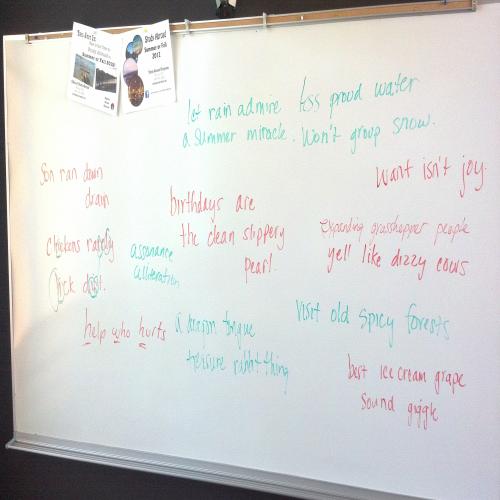
We started today with the students writing 25 word stories in their composition notebooks.  I showed the campers the examples on Kevin Hodgson’s Prezi.  The campers enjoyed the many stories that were in the Prezi.  We then proceeded to share our own 25 word stories out loud.  Participants did an amazing job!  We then quickly transitioned into our poet coming in and speaking to them about writing and what it means to be a poet/writer.  Robert Fanning was our poet and he did a super job with his presentation.  He had the students create this huge word wall on our whiteboard and then he read some poems to the kids.  He discussed the power that words have, something that students today need to hear again and again. At the end of his presentation, he took the campers down the hall and opened a box full of words on pieces of paper.  He then had the students throw them in the air and once they landed, the students needed to form lines of poetry. He instructed them to be silly and non-traditional and I was impressed with how our campers worked on this.  I was even more impressed by one young man who had some really powerful lines.  Below are some pictures of the activity and the lines individuals came up with:


When our poet departed today, the students wrote three different poems.  They wrote something called a diamond poem where they started with a topic like female and then end up at the complete opposite which would be male in this case.  In addition to their diamond poems, they wrote haiku poems and then collaboratively wrote a poem that rhymed.  You can see student work on youthvoice.net. Their work is under CRWP and writing poems.  I encourage you to check out some of their work.

Throughout the time the participants were working on their writing they used Ipads for the duration of the day.  Some campers had experience with using Ipads, others did not.  Students were actively engaged in writing using Google Doc/Drive and Youth Voices.  There were very few gliches and overall, the students did a plethora of writing today incorporated with the use of technology. They finished out their day responding to other camp participants work on Youth Voices and trying to polish their detective skills by solving some of the staged scenes that were posted on to the Youth Voices website.

With all of the writing the campers have done so far, our goal for this camp is to look at a way we can incorporate the three major areas of writing the Common Core State Standards focuses on: narrative, informational, argumentative.  Yesterday we asked our participants to be detectives and try and solve a murder which led them to writing a police report, a great lead into argumentative writing.  Today, we focused on poetry, part of the narrative world of writing.  Thursday we will look at research, a type of informational writing.  Our adventure continues tomorrow as we embark on our writing marathon and hear another guest speaker.

Cheers!