BYOD: It Can Work!
I recently read an article from Emerging Edtech titled 5 Reasons Why BYOD is a Bad Idea. As an online subscriber, I immediately read the article when it entered my inbox. Not to mention, I am a huge advocate for students using cell phones in the classroom. After all, I am writing a book about it. The article outlines 5 areas or reasons why it is a bad idea for students to bring their own device into the classroom. I want to address each one of these individually and point out why it can work, even in a small rural district where I teach.
First, the article addresses, equipment inequity. Okay, so not everyone is going to have the same phone, tablet, etc. The article argues there will be many inconsistencies when dealing with many different brands, and types of devices. There are some easy solutions to this quandry. For example, my students started to use cell phones in my language arts classroom this year and I had students who had iphones, flip phones, smart phones, “dumb” phones, etc. As a teacher, I had to keep this in mind when it came to incorporating technology into my existing lessons. So, I used a social platform (Celly) that supported both smart phones and “dumb” phones. I don’t think there is a need to worry about the equipment being brought in by our students. Educators need to find website, social platforms, etc. that can be supported across the board. Furthermore, doesn’t every teacher have an alternative plan if something doesn’t work? My students can log onto the classroom wikispace to work and with the amount of students who bring in their own devices, I can get them on a computer in our lab.
Next, tech support is discussed as a downfall. In comparison to the first issue the article discussed, it basically is echoing the same thing. Because students will have different devices, there will be different issues with software and configuration. The article doesn’t give exact specifics. I suggest as a teacher who is interested in doing this to do your homework. Research what devices your students have and see which ones could potentially cause you the most headaches. Also, as mentioned before, choose a digital tool that can be supported on a various devices. Trust me, they are out there. The article also said the tech support would pick up more problems. Why? It seems to me that if students are bringing in their own device, they should know how the device works. In addition, I would hope the teacher is comfortable with using technology and perhaps could provide assistance to the students. Teachers should also know when to draw the line when it comes to how much time is being eaten away due to technological problems. As mentioned before, having a plan B helps.
The third point the article brings up called bring your own distraction is grasping at straws. Yes, students do have distractions on their devices. I had students who had apps, games, or music on their phones and it was never an issue. First of all, my students and I have a mutual respect about the use of their phones. I have never given my students a sheet with a set of rules and regulations regarding their phones. The only rules my students were solidly aware of were the school wide rules. It was really amazing how my students never had their phones out when they weren’t supposed to and the number of times I had students ask me to get their cell phones out. I firmly believe the respect given by me to them when it came to their device fed into the respect they gave back to me when it came to the use of their devices. Oh, and the other point I want to argue is any teacher who has quality classroom management will have very few issues.
Internet Content Filtering is the fourth issue addressed in the post. I completely understand this point, however, if students are bringing in laptops or tablets, students are going to have to connect to the network being used at the school. Then, the content can be filtered. On the other hand, I know students who have 3G and 4G on their phones and I also have both on my phone. There isn’t a big difference between the two. When using cell phones, there can be an issue about accessing inappropriate sites. With firm acceptable use policies in place, student expectations aren’t a guessing game. If students aren’t using the device for what is was intended, then they lose the privilage of using it at school. Teachers can’t just sit at their desk either after giving the student an assignment. They need to circulate and monitor their students the best they can to make sure the students are on task.
Finally, the mine is better than yours syndrome is not a solid enough reason to not incorporate a BYOD policy into a school. I am around middle schoolers and high schoolers every day and I don’t see this with technology nearly as much as I do with a pair of shoes, or clothing. Some students are going to have a better or different device and I am sure there are going to be instances where students don’t have anything at all. Growing up my best friend had the latest Nintendo, Sega, etc. and I never hated him or made fun of him. He never flaunted it to anyone either. The only grade levels I could potentially see this would be in the elementary levels. Nevertheless, this argument shouldn’t deter anyone from wanting to use tech devices in their classroom.
I normally don’t look to be argumentative with what I read online when it comes to professional publications, but this particular post/article struck a few nerves. I had a very successful year with students bringing their own cell phones. Like with any lesson or unit in the classroom, I did have hurdles from time to time, but it wasn’t anything we couldn’t overcome. I had a wide array of phones brought in and I had students who didn’t have them. As a teacher you make adjustments and have alternative methods to meet the needs of all of your students.
Cheers!
CRWP Middle School Writing Camp: Day #4
With the final day of middle school writing tech in the books as of yesterday, I can officially say it was a huge success. I would have completed this post yesterday, but I needed to catch up on some much needed rest. The very last day I did a video writing prompt with the kids. We watched the Duck Song which is easily accessible on Youtube. If you type in Duck Song in the search box, you won’t have a problem finding it! Upon completion of viewing the video, I asked the campers how the video was related to writing and what made it so appealing. We also discussed the idea of visual literacies. The campers really wanted to make their own video that mirrored the Duck Song, but unfortunately we didn’t have the time. It may be something to consider for next year.
Upon completing their writing into the day with the video prompt, we had our last guest speaker. Our last speaker was an individual who was a head of some of the food services at CMU. He actually runs the small bagel shop in the EHS building. He discussed with the campers what someone in his position does on CMU and how the food service works at CMU. I myself was really amazed at the processes that took place to meet the needs of all of the CMU students when they are all on campus. Creating surveys and reports on student population were just a few of the items he discussed dealing with the writing world.
When our speaker was done speaking, he took us on a tour of one of the dining places on campus. It was huge! The kids really were able to understand better what has to take place to feed over 6000 students who attend CMU. The students really enjoyed their free ice cream too.
After returning from our tour and eating a quick lunch, we talked to the students about fast food and doing research on some of their favorite fast food restaurants or foods. The students learned about the research process and what to look for in a trustworthy source, especially when it comes to the internet. Though the students didn’t have an enormous amount of time because it was the last day, the students were given more specific topics dealing with food and asked to research their topic online and then report back what they find. Some students wrote a small blurb, others showed a short video. This lesson/activity they did is great, but I would like to introduce it to them on the first day next year and then by the end of the week they can present their findings in a digital video, podcast, or a glog of some sorts. They could even create a cartoon on toondoo.com to create some sort of venue to show what they have learned. It was a lot for them to do in one day.
At the end of the day, the campers worked on their piece they were going to submit for our anthology. Each student contributed one piece to our anthology and as co-directors we are putting together an anthology which will be mailed to them. After they were done polishing their piece and sending it to me via Google Docs, they anxiously waited for their parents and guardians to arrive. The participants then took some time to go over all of the work they completed throughout the week and showed them Youth Voices. This lasted about a half hour and then we came back together as a whole group and volunteers shared with the whole group.
Overall, I feel the camp went really well. The students seemed to have a really great experience using the Ipads, listening to various speakers talk about writing, and visiting different places to get inspired to write. It was incredible how many of the campers came up to me to say thank-you for the week. It meant a lot to me! In addition, there were many parents who commented on the fact that they would be back next year. With this being our first year, there are a lot of thing we can improve upon. On the other hand, we are hoping this group can be a solid base and all of them return next year. I definitely want to direct again next year and incorporate Youth Voices once again too. Thanks to all who have followed our adventure this week!
Cheers!
CRWP Middle School Writing Camp: Day #3
Day 3 of writing tech camp is in the books! My how time will fly. We spent the first half of the day doing our writing marathon. For those of you who are not familiar with the National Writing Project and their work, participants of the summer institute do a writing marathon where we visited different places and wrote. With the middle schoolers, we visited the campus greenhouse, the sports arena complex, and the library. The students not only had various places and items to motivate and inspire them to write, but they learned about some wonderful places on CMU campus.
Upon completing our marathon and returning to our lab, the students took time to cool down and eat their lunch. Then, we had another guest speaker talk with the students. Our free-lance writer writes for the CMU paper and shared two short videos with the students about her trip to Mexico where her and some other students who are going into teaching, worked with students who had very little. The video was great and she used it as a lead into a discussion about how our writing should be as if we are looking through a video camera lens. Our writing should invoke all our senses. We should use as many senses to appeal to the readers of our writing. She completed a writing activity with the students that allowed them to choose from several different prompts and then the campers found ways to make their writing better by answering some questions that surrounded the prompt. In addition, they learned synonyms that made their writing stronger. For instance, words like polite, kind, friendly, likable, and charming can be used instead of “nice”.
To conclude our day, the campers worked on completing their pieces of writing from the marathon we embarked on earlier in the day. I posted two discussions on Youthvoices and the campers need to post to those discussions. In addition, we had them continue to work on the stories they did with our guest speaker as “free-lance writers”. The other co-director decided we also wanted the campers to go back and “polish” their writing so that it wasn’t completely riddled with errors. I know there are professionals out there that would put more emphasis on grammar, sentence structure, etc. However, I am more interested in hearing the participants ideas and seeing them transform their ideas into pieces of writing, no matter what mode that writing may take on. In addition, it is important that the students express their great ideas into a piece of writing that represents them. We can worry about the polishing later.
Now that we are nearing the end, I have been reflecting back on the past few days and I am thrilled with the group of campers we have. They have great ideas and their word choice is incredible when it comes to their writing. Our guest speakers have been truly impressed with the originality of the their ideas.
I would definitely give the students more time in between the places we visited, so the students have more time to write. I feel as if they were rushed today as we went around campus. Furthermore, I would like the students to use more technology like podcasts for their poems and such. More thoughts on that to come.
I am saddened to say tomorrow is our last day, but I am excited for the fact the students get to take some time at the end to share with us and their parents what they have been doing all week. It should be a great time as we discuss research and the food industry. I can’t wait to blog about it tomorrow. Until then…
Cheers!
CRWP Middle School Writing Camp: Day #2
With our second day of middle school tech writing camp complete, I am no doubt more fired up about the campers and their writing, but I am also exhausted. Today was a huge poetry day along with tying up some loose ends with our writing yesterday.
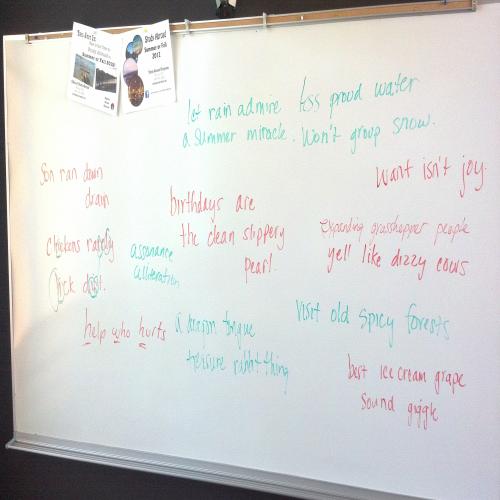
We started today with the students writing 25 word stories in their composition notebooks. I showed the campers the examples on Kevin Hodgson’s Prezi. The campers enjoyed the many stories that were in the Prezi. We then proceeded to share our own 25 word stories out loud. Participants did an amazing job! We then quickly transitioned into our poet coming in and speaking to them about writing and what it means to be a poet/writer. Robert Fanning was our poet and he did a super job with his presentation. He had the students create this huge word wall on our whiteboard and then he read some poems to the kids. He discussed the power that words have, something that students today need to hear again and again. At the end of his presentation, he took the campers down the hall and opened a box full of words on pieces of paper. He then had the students throw them in the air and once they landed, the students needed to form lines of poetry. He instructed them to be silly and non-traditional and I was impressed with how our campers worked on this. I was even more impressed by one young man who had some really powerful lines. Below are some pictures of the activity and the lines individuals came up with:
When our poet departed today, the students wrote three different poems. They wrote something called a diamond poem where they started with a topic like female and then end up at the complete opposite which would be male in this case. In addition to their diamond poems, they wrote haiku poems and then collaboratively wrote a poem that rhymed. You can see student work on youthvoice.net. Their work is under CRWP and writing poems. I encourage you to check out some of their work.
Throughout the time the participants were working on their writing they used Ipads for the duration of the day. Some campers had experience with using Ipads, others did not. Students were actively engaged in writing using Google Doc/Drive and Youth Voices. There were very few gliches and overall, the students did a plethora of writing today incorporated with the use of technology. They finished out their day responding to other camp participants work on Youth Voices and trying to polish their detective skills by solving some of the staged scenes that were posted on to the Youth Voices website.
With all of the writing the campers have done so far, our goal for this camp is to look at a way we can incorporate the three major areas of writing the Common Core State Standards focuses on: narrative, informational, argumentative. Yesterday we asked our participants to be detectives and try and solve a murder which led them to writing a police report, a great lead into argumentative writing. Today, we focused on poetry, part of the narrative world of writing. Thursday we will look at research, a type of informational writing. Our adventure continues tomorrow as we embark on our writing marathon and hear another guest speaker.
Cheers!
CRWP Middle School Writing Camp: Day #1
It is without a doubt a whole different world when you are talking to middle schoolers about writing when they actually care and want to be writing. All in all, the first day of middle school tech writing camp was a success. I now understand what NWP directors go through with logistics on the first day. My co-director and myself spent a good portion of the morning getting a majority of our students signed up for their Google accounts so they can use google docs. Unfortunately the Ipads were not ready today so the students had to use their composition notebooks, which isn’t a major set back, it was just frustrating when it is a middle school tech camp and they couldn’t use the technology.
After their writing into the day was completed, we focused on argumentative writing with the campers and we used George Hillock’s Teaching Argumentative Writing and Crime and Puzzlement by Lawrence Treat. The campers looked at two different cartoon murder scenes and wrote down what evidence or facts they saw in the picture. Then, they used that evidence to form a rule or warrant. If the evidence did not answer all of the questions the campers had, they wrote down those questions. The students worked in groups on this and eventually they wrote a police report. Before the students wrote their reports we had a detective from the CMU police department come in and speak to the campers about his job and what police reports look like and why writing is important in police work. The students asked great questions about his profession and they asked really smart questions about the reports they were writing. In addition to the detective, we showed a model of an actual police report that was done on a car theft. I also showed the campers a short youtube video on writing a quality police report. The video had to be slowed down because it went to fast, but the students were able to understand what we were asking. When the students were done with writing their reports, all four groups shared out their report. Next year, I am hoping they will be put into a google doc and then be shared with the other groups so they can collaborate and get feedback from their peers.
The really fun part came in the afternoon when the students got to use the digital still cameras and the digital video cameras. The campers were instructed to make their own murder scene and take digital still pictures of the staged murder scene similar to the ones that were given to them earlier. In addition, the campers were to take the digital video cameras and record a narrative that would explain the scene for others to follow. Before the students were allowed to wander the building and stage their murder scenes, they needed to develop and write out their plan for what they wanted to do. Furthermore, they needed to write out a script for their narrative. Once their scripts and plans were approved, they were able to start staging their scene. What I want to do is load their images and videos into youthvoice.net. Then, I want the camp participants to go to youth voices and watch other groups videos and look at their pictures. After viewing other groups work, I want them to comment on their work. I have to upload their work tomorrow morning to the youth voices website.
The last item I had participants complete today was write a short reflection on the days events and discuss what they might have learned about argumentative writing, visual literacies, writing as a whole, etc. Reflecting on my own work today, I want students to have more time to play with the digital cameras. I would also like to bring them in props to use next year (if we go this route). It would also be beneficial for the participants to have more time to plan for their murder scene and script.
Again, it was a very successful day. I feel that it went well and it extremely fast. Tomorrow we are exploring poetry and we have a poet lined up to come in and speak to the students. It should be a blast!
Cheers!
Measuring Growth in a Language Arts Student
As my second week of summer vacation comes to an end, I find myself scratching my head and wondering where the summer is going so quickly. Ahhh, such is life. Right now I can’t help thinking about measuring the growth of students in a Language Arts classroom. The Michigan Department of Education and our beloved state government (Sense the sarcasm there?) wants to measure our ability as effective teachers based on the growth in our students. The measurement for this growth will come from a combination of things. One of them being standardized testing. Now, what that test will be is still yet to be determined. In addition, I am confident saying that part of the growth needs to be proven by the teachers as well. Currently a major portion of the teachers at my school give a pre-test at the beginning of the year and then a post test at the end of the year. To be honest with you, I don’t have a real issue with this process. A pre and post test can be beneficial for a math teacher. I have always argued that quantitative data can be used more for math and science. However, it doesn’t work necessarily for a Language Arts classroom. As a language arts teacher I am looking for the qualitative data that can only be found in my student’s writing. Giving students grammar sheet homework daily and the mundane drill and kill exercises only turns them off and I don’t feel it clearly measures their abilities or their growth. When it comes to reading nothing turns me off more than seeing a worksheet packet given with a novel. No wonder our students don’t want to read. Would you want to read knowing every time you did, the worksheet packet was looming over your head? Kelly Gallagher talks about this in his book Readacide.
The argument that I have had in the past with colleagues is I can’t input data into a data collecting system when it doesn’t measure what my students can really do or what they have learned over a school year. It is impossible for me to do that with a student and their writing. On the other hand, I know I can give my students a typical comprehension test over what they read; that is easy. But does it really give me accurate feedback on how my students have grown? I think not. Though I could debate about a student’s growth in reading and find some tools to help me, I am more interested in the writing portion.
Recently, before the school year ended, I met with two of our high school English teachers to discuss Google docs and Schoology. As the meeting progressed we discussed how to measure growth in our students and what is the best way to achieve our goal. We all agreed that writing portfolios are the best way to show the growth in our student writers. We are going to take it one step further and next year we are all going to have the students do digital portfolios. We will use Google docs seeing how our school is going to Google apps. Students can simply make a folder in Google Docs and then take the portfolio with them each year. Obviously you can get more complex with the idea of a digital portfolios. Visit http://www.michiganportfolios.org to see examples, resources, etc. It is a super site for getting started with this idea. I am attending my second workshop in 2 years in August on the idea and I hope I can get it fully implemented next school year. This past year I only began the process and didn’t fully execute it. My principal is in full support of us doing this from middle school to high school and I believe it will be a true reflection on how the students grow as writers. I will publish some blog posts on the subject as I go through the process.
Cheers!
Writing Reflections
On Thursday of this past week I asked my 8th graders to reflect back on their writing they have done this year. Earlier in the week as I was developing my lesson plans I began to really think about the writing we have done this past year. As I do every other year, I began to feel guilty because I was thinking I didn’t assign enough writing for them to do throughout the year. So, when I described the reflection assignment for my students, we composed a list on the board. If I was thinking about it, I would have taken a picture of the list and just posted the picture, but instead I will have to compose the list again here. Below you will see all of the writing I have done this year with my 8th graders.
1. This I believe Essay – Posted to our classroom wiki.
2. Alternate endings for The Giver by Louis Lowry (Students could do a traditional writing, Glog, or Comic Strip.
3. 25 word story
4. Sentence in a day
5. Compare/Contrast Essay between characters in The Outsiders by S.E. Hinton
6. Glog or Book Cube for Christmas break book (See previous post I have written).
7.Celly writing – writing journal prompts and collaboration with cell phones
8. Journal Writing on various topics every day
9. Extended journal writings – Students went back through previous journal writings and found ways to make them more detailed and better.
10. 50 word stories
11. Paper Tweets – a two day lesson on Twitter and tweeting.
12. Biographies – Posted to our classroom wiki.
13. 8th Grade Reflection writing
14. Police Reports – Modeled after George Hillocks Argumentative Writing Book
15. Musical Chair Writing – Post a comment or send me an email if you want information about this activity.
16. Article of the Week – (Title does not reflect the fact I didn’t do this every week)
17. Science Fiction Stories
18. Ticket out the door writing responses.
Now for the sake of time and not boring my few readers, I will just say there are a few more writing activities that I have not posted. When I reflect back on the amount of writing my students did this year, I have nothing to feel guilty about. My students definitely did more writing than I did grading. Kelly Gallagher argues this in his books. We as teachers do not need to be grading everything our students do. There were many occasions my students turned in writing and it was graded on a formative scale rather than be a summative grade. What I really noticed is how much digital writing my students have done this year. My students wrote on Glogster, toondoo, used Celly phones in class, they used Google Docs/Drive and helped create a paperless classroom and used it regularly for collaboration.
The other thought I had was about academic rigor. The Common Core Standards essentially helps guide teachers to develop more rigor in our classroom. I still believe my students can do more writing and I will push my students to do more writing next year and the years to come. If you want any information on any of the listed writing above, feel free to email me or make a comment.
Cheers!
Another Possible Use for Cell Phones
It is no secret that I am working on a book about cell phones. I will not go into a lot of details because I don’t want to give anything away. When one writes informational text, there is a certain amount of research that has to be done. I have been actively engaged in reading Teaching Generation Text: Using Cell Phones to Enhance Learning by Lisa Nielson and Willyn Webb and Toys to Tools: Connecting Student Cell hone to Education by Liz Kolb. Both Books are resourceful and cutting edge. While reading these books I stumbled across a website called booksinmyphone.com. The site is designed for a user to read books in your cell phone, a nice alternative to those students who don’t have a kindle, nook, or other e-reader. In addition, there isn’t any cost to download the books. Also, you can write your own book and upload it to their website. The website itself is easy to navigate. You can browse through books by title or author and there are is a page that walks you through how to get the books onto your phone. Now, I have not used this website/tool on my own phone and I have not had any students use it. I can, however, see how this could be used in my classroom or other classrooms.
First, I can see using this tool during my mythology unit. There are a few myths my students read in class and this could be a great tool to use along with Celly. The website has Beowulf, Aesop’s fables, Moby Dick, The Iliad, and The Odyssey. How I envision this for my class is to have my students read one of these tales or myths on their phone after they have downloaded it (the website claims it works on “dumb” phones). After they read the story, I would have students grouped into a “Cell” on Celly and have them collaboratively have a discussion about what they read as homework or each student could write an extension of the story from one of the character’s perspective. Google Docs is another possible tool to us here next to reading the book.
Besides looking at myths, there are a plethora of classics available for download. With the Common Core Standards (CCSS) pushing for the reading of more classic texts, this could be a tool that could enhance the language arts classroom. A Tale of Two Cities, Around the World in 80 Days, and Common Sense are just a few I came across looking at the website.
The downside here is creating an alternate activity/lesson for those students who don’t have cell phones. Students may have to have paper copies and post to the class Wiki space or call my Google phone number and leave a voice message in response to the reading. No matter what is chosen, there has to be an alternative to those without cell phones.
There are still critics out there viewing this as just another excuse to use cell phones in the classroom. In my opinion, this is another way to connect with my 21st century learners that I teach every day. Our students are engaged more with their devices, it is time to take advantage.
Cheers!
Letting My Students See Me Struggle
It has been some time since my last post and I apologize to my readers. Fortunately, I have been working on other writing that can benefit me professionally. Today dealing with 21st century learners can be a bit of a challenge for us in the language arts world. It isn’t enough to simply say to today’s learners that class is going to be fun or the topic we are going to write about is going to be of interest to you. Let’s face it, teaching students, especially middle schoolers how to write is a challenge. You add the CCSS to that equation, we now have to be more prepared in our classrooms to teach our students. As I have been spending an absorbent amount of time writing these last 3 weeks, I have given a lot of thought about how to make my students better writers. Though I am confident I do a solid job modeling for my students what I want to see out of their writing, I have failed to show them one side of me as a writer. I have failed to show my students the times I have stumbled or struggled with my own writing. All of the writing my students have viewed that belongs to me have been either finished or close to a finished product.
As I continue to find new ways to better myself as a teacher of writing and my students, I have realized they need to know about the times I struggle and what I have done to overcome those moments. Since the end of April I have been working on a book proposal and as my Thursday night writing group critiqued me and gave me valuable feedback last week, I knew I had to go back and do some major revision to my writing and make my voice more present in my writing. My audience needed to hear me and not a superficial voice that didn’t represent me or my writing. This has been somewhat of a struggle for me, but I have persevered. Then, I remembered, I didn’t share this particular uncomfortable adventure with my students. So, when I return to school, I will take the time to talk to my students about how I struggled with my writing.
So, why do I feel this is important for not just me, but other teachers to do in their classrooms? First, if I want my struggling writers to take the risk of making a mistake, they need to see me, the teacher/expert make mistakes and know that I am a human being who struggles with writing from time to time. I feel there are language arts teachers out there who find it easy to stand in front of a classroom and bark at their students about how a piece of writing should be constructed, but the teacher themselves don’t show how they go through the writing process and discuss with students how they struggle with certain parts of their own writing. Show them your not perfect. Second, modeling is by far one of the most important aspects of teaching. On the other hand, if a teacher actually writes with their students, they send a clear message to their students; writing is important! In my professional opinion, writing with your students is the best form of modeling a teacher can display for their students.
Finally, I want to leave my readers with this final thought, especially if you are a language arts teacher. Think about how many times your have shared your own writing with your students. It can be visually, or orally. If you don’t regularly do this in your classroom, I encourage you to start now. I don’t care if it is nearing the end of the year and you are trying to squeeze in the last of those curriculum requirements, share your writing. There are a lot teachers who lack the confidence to share there writing. I completely understand your position, but we need to be learners too and allow our students to catch a glimpse of what goes on inside of our heads. Who knows, we may gain some valuable insight from our students about our own writing. If a writing workshop classroom is what you desire, you will never gain your students trust if you don’t share your own writing. By sharing our own writing students are not so reluctant to share their writing and we as teachers might learn more about our students, other than the obvious fact they are language arts students in our classroom.
Cheers!